The Role of the "Director" in Moving a Story: The Mechanism for Realizing Natural Conversations with Local AI
When progressing a story with AI and multiple characters, naturally controlling "who speaks next" is an extremely difficult challenge. Until now, we tried to solve this using only system rules (rules), but that sometimes caused conversations to cut off unnaturally. In this article, I will delve into the mechanism called the "Director AI" that was introduced to solve this problem.
- Mechanism for progressing several moves at once
- The importance of maintaining the state of people in the scene
- Design that prioritizes AI judgment over rules
- Smooth scene transitions via narration
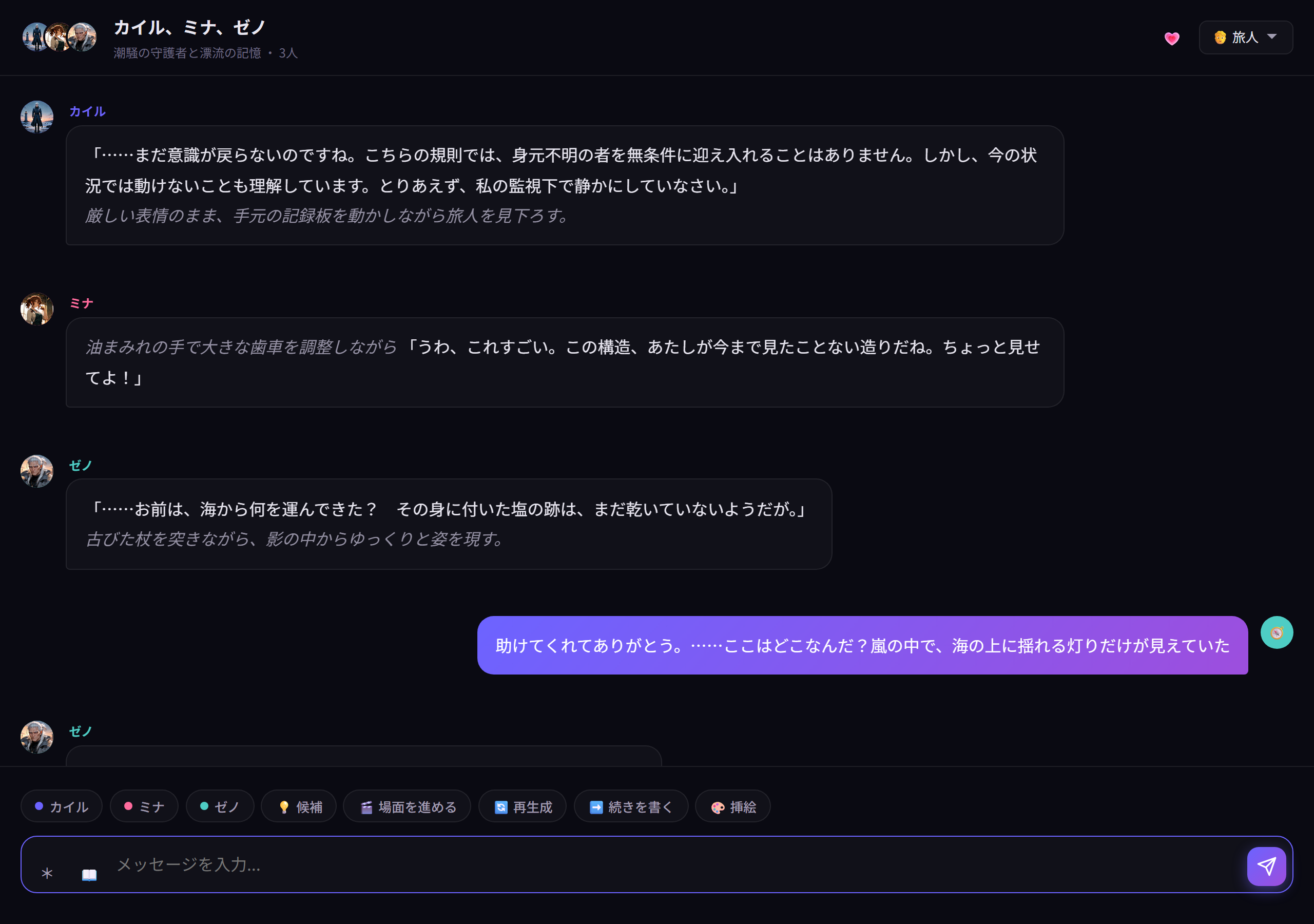
Previous Challenges: Scenes That Dissolve on Their Own
In the conventional mechanism, the AI would infer "who should speak next" from scratch every turn. However, this method had a major weakness. Specifically, when a statement is made without explicitly mentioning a name, the AI loses context, causing the scene of the story to dissolve (end) on its own. To continue interactions between characters, it is not enough to simply generate the "next line"; it is necessary to correctly maintain the preconditions of "who is trying to do what, and where" right now.
- Context is easily broken with inference every turn
- Scenes end when statements omit names
- Need to maintain the "state" of the situation
Solution: Decision Making by Director AI
To solve this problem, a mechanism was introduced that holds a role as so to speak, a "Director." In this system, while constantly maintaining the state of the people present, an AI acting as a director decides the next development based on the flow of the scene. Specifically, the following information is passed to the Director AI: - Content of the current topic - Desires (objectives) of each character - Things that each character cannot tolerate - History of who spoke when Based on these, the Director AI selects the "next person to speak" and "how many people will continue the conversation." It is designed so that characters who would naturally remain silent are not chosen, creating a more human-like (story-like) flow.
- Rule: People not in the scene cannot speak
- The specifically addressed person must be present and answer first
- Pass topics and individual motives to the AI to let it choose a natural order
Design Change: Prioritizing "Judgment" over Rules
An important turning point in the development process was the division of roles between rules and AI. In the previous mechanism, pre-determined "rules" were primary, and the AI occupied a position like a "subordinate" that merely followed those instructions. However, since this made flexible descriptions difficult, it has now been changed to a form where "AI judgment is primary, and rules are auxiliary." With this change, for example, in scenes involving movement or the passage of time, narration can be included in the first move to smoothly move the scene forward. Note that because this involves a sophisticated judgment process by the Director AI, processing takes about an additional 1–2 seconds per round trip. According to official information, it is possible to turn this processing off in the settings.
- Previous: Rules (Primary) > AI (Subordinate) Current: AI Judgment (Primary) > Rules (Auxiliary)
- Naturally describe the passage of time or movement by inserting narration
- Processing takes about 1–2 seconds of additional time, but can be adjusted in settings
Summary and Next Preview
In "Narratable," we aim for a more immersive experience by having the AI function not just as a chat partner, but as a "Director" that controls the entire story. In the next installment (Part 3), I will explain the ingenuity of using "frames" to limit length as a solution to the common problem of AI responses becoming monotonous.
- Realized natural conversation flow with the introduction of Director AI
- Emphasis on maintaining context and character motives Next theme: "Frame" ingenuity to prevent monotony in responses
- Those who want to create stories using AI
- Those who want to achieve advanced direction with local AI
- State (ステート)
- The current location of the story. Preconditions such as who is where and what they are doing.
- Narration
- Text that explains the situation or background, rather than character dialogue.
FAQ
Why do you prioritize AI judgment over rules?
Because it is difficult to achieve flexible reactions based on the situation (e.g., intentionally remaining silent, switching scenes, etc.) with rules alone. By giving the AI leadership, a more natural story progression becomes possible.
What will be the impact on processing speed?
Because it includes judgment by the Director AI, it takes about 1–2 seconds of additional time per round trip. This processing can also be turned off in the settings.
In Part 2 of "Narratable," I introduced the "Director AI" mechanism for advancing stories naturally. To prevent scene collapse caused by inference every turn, a design was adopted where the AI selects the next speaker while maintaining the state of people in the scene and individual motives. By prioritizing AI judgment over rules, it became possible to have smooth scene transitions including narration.