Fusion of AI x Gamification: The Secrets of Presentation and Growth Systems that Turn Learning into 'Play'
Turning 'study' into 'play' is the key to continuous learning. In this post, we deep dive into the gamification mechanics introduced in AI Mahjong Dojo.
- A system that evaluates correct discards as 'combos'
- Visualization of growth through experience points and missions
- Diverse visual presentations to enhance immersion
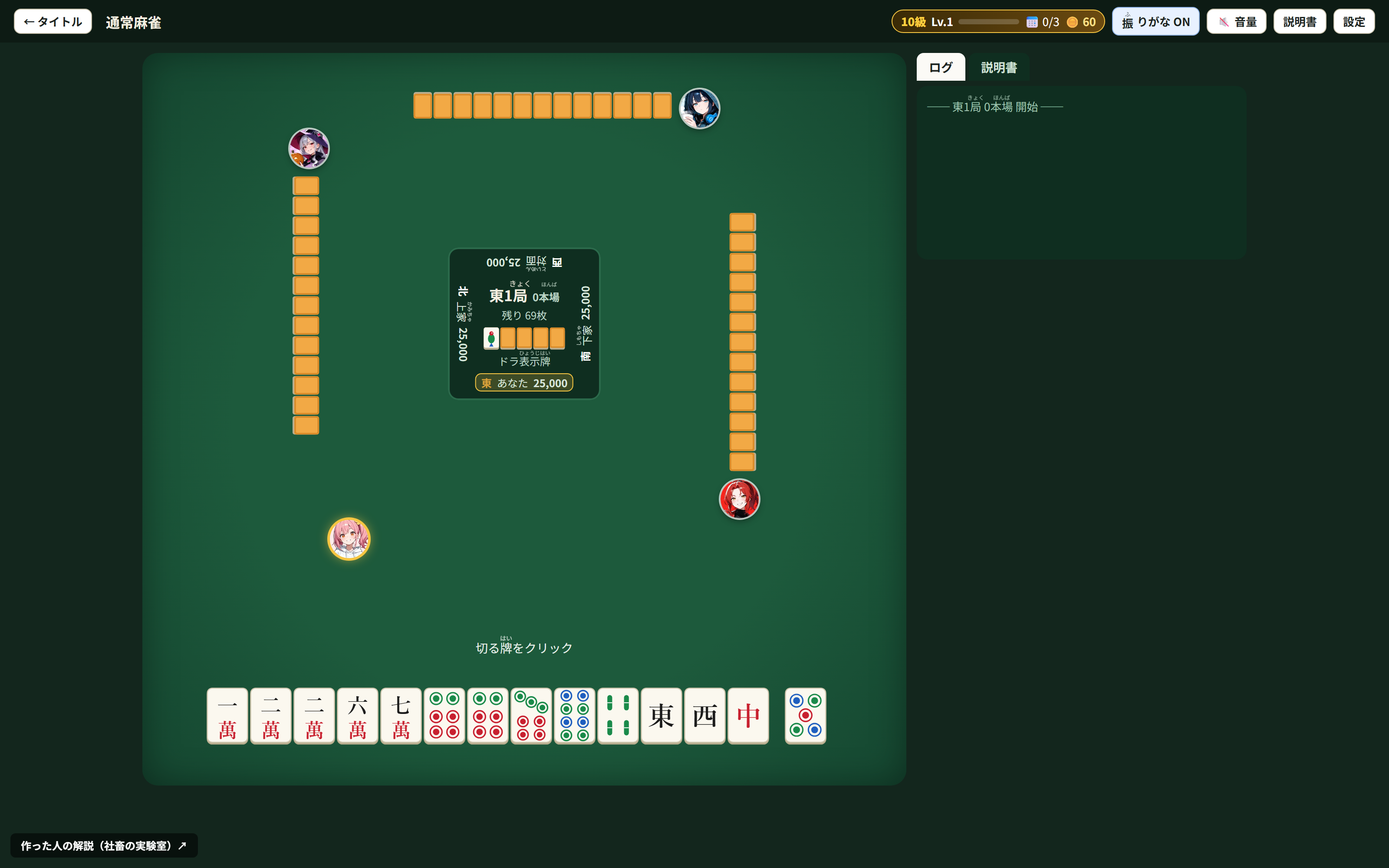
From 'Memorizing Correct Answers' to 'Chaining Combos'
The previous version of 'AI Mahjong Dojo' focused primarily on learning the correct answers by simply looking at the AI's recommendations. However, to ensure continuous learning, a 'sense of growth' and a 'feeling of accomplishment' are essential.
To address this, we introduced a combo system that evaluates your own discards. The key point here is that the count is only added when you choose the correct answer by your own will before looking at the recommendation. It is not counted if you choose it after confirming the answer, creating a mechanism that encourages pure improvement of skill.
Furthermore, in the random question (What to discard) mode, we added a mechanic where consecutive correct answers trigger a 'FEVER' state. This provides a game-like sense of pleasure for the act of accumulating correct judgments themselves.
- Combos are added when you choose the correct answer before looking at the recommendation
- Not counted if chosen after looking at the answer
- Successive correct answers lead to a FEVER state, accelerating the pace of learning
Visualizing Progress with Level-Ups and Missions
To make learning progress clearer, we integrated a growth system similar to an RPG. A system where your rank or grade increases based on the experience points earned from correct discards.
Additionally, to provide more concrete goals, we also prepared 'Achievements' and 'Today's Missions.' For example, by completing all of today's missions, you can earn a bonus, allowing users to set small daily goals for their learning.
Note that these growth records are stored only within each user's browser, allowing you to record your growth while maintaining privacy.
- Ranks and grades increase based on experience points
- The fun of unlocking Achievements (18 in total)
- Clear daily missions (3) to earn bonuses
Commitment to Presentation for Enhanced Immersion
To make it easier to continue learning as 'play,' we significantly strengthened the visual presentation. Rather than just displaying text and numbers, the screen reacts according to the situation, creating the tension and excitement unique to Mahjong.
Specifically, we added effects such as the screen glowing during your own reach, an opponent's warning, or chances for tenpai and ron. Also, depending on the magnitude of the win (points), effects like screen shaking, light, rainbows, and lightning change in stages.
Furthermore, we adopted a drum roll for the announcement of ura-dora and a rotating effect like a slot machine reel for the final score determination. On the result screen, the hands are displayed in order, and the score counts up while stamps like Mangan are applied. This maximizes the pleasure of 'rewards' obtained during the learning process.
- Presentations such as glowing, warnings, and screen shaking according to the situation
- Staged effect changes based on the size of the win
- Presentations using drum rolls and slot-style score displays
Customization for the User
While strengthening the presentation, it is also important to provide a comfortable environment for all users. Therefore, it is possible to change the intensity of the presentation, reduce flashing, or turn off the discard evaluation display itself from the settings screen.
The point is that you can adjust the operating environment according to the situation, such as when you want to focus or when you want to play and relax according to your own preference.
- Freely change the intensity of the presentation
- Visual adjustments possible, such as reducing flashing
- Setting available to turn off discard evaluation display
Summary: The 'Mechanisms' for Continuous Learning
When learning using AI, the most difficult thing is 'continuing.' In this update, we pursued how to fuse the 'education' aspect of AI guidance with the 'fun' of a game.
All of these presentations and growth systems are aimed at 'continuing learning enjoyably.' In the next installment (Part 5), we plan to discuss 'Online Battles with Friends' as a further development of these contents.
- Fusion of education (AI guidance) and play (presentation/growth)
- Importance of game elements to encourage continuity
- Next time: Explanation of the 'Online Battle' function
Question for the Reader
Have you ever experienced your motivation changing because of 'game-like elements' when learning something? Please let us know in the comments.
- People who want to continue learning using AI
- People interested in game mechanics
- People who want to try tools that run on their own PC or browser
- Combo
- A mechanism where points or effects are added when specific actions (in this case, correct discards) are successfully performed consecutively.
- Win (Agari)
- In Mahjong, winning points based on specific rules and ending the game.
- Ura-dora
- The judgment of cards (dora) that may allow for additional points to be earned after a win.
FAQ
Are growth records shared with other users?
According to official information, growth records are only saved within the browser of the person playing.
Can I turn off the presentation?
Yes, you can change the intensity of the presentation, reduce flashing, or turn off discard evaluations in the settings.
AI Mahjong Dojo elevates learning into 'play' by introducing a combo system, experience points, and diverse visual presentations in addition to advanced AI guidance. All of these are designed with the goal of allowing users to continue learning enjoyably.