
[AI Mahjong Dojo] Automatically Generating "What to Discard?" Problems with AI. Explaining the Mechanisms and Improvements to Prevent Beginners from Getting Stuck
The first wall that people who have just started playing mahjong hit is the judgment of "What should I discard in this situation?" I have implemented a system that uses AI's analytical power to automatically generate these "What to discard?" problems and provide instant explanations.
- A problem generation system that asks for the "next move" from real battles between CPUs
- Consistent correctness judgment using the same analysis algorithm as the flow explanations
- "Furigana" feature for beginners and a persistent instruction manual
- In-browser sound synthesis that minimizes external communication
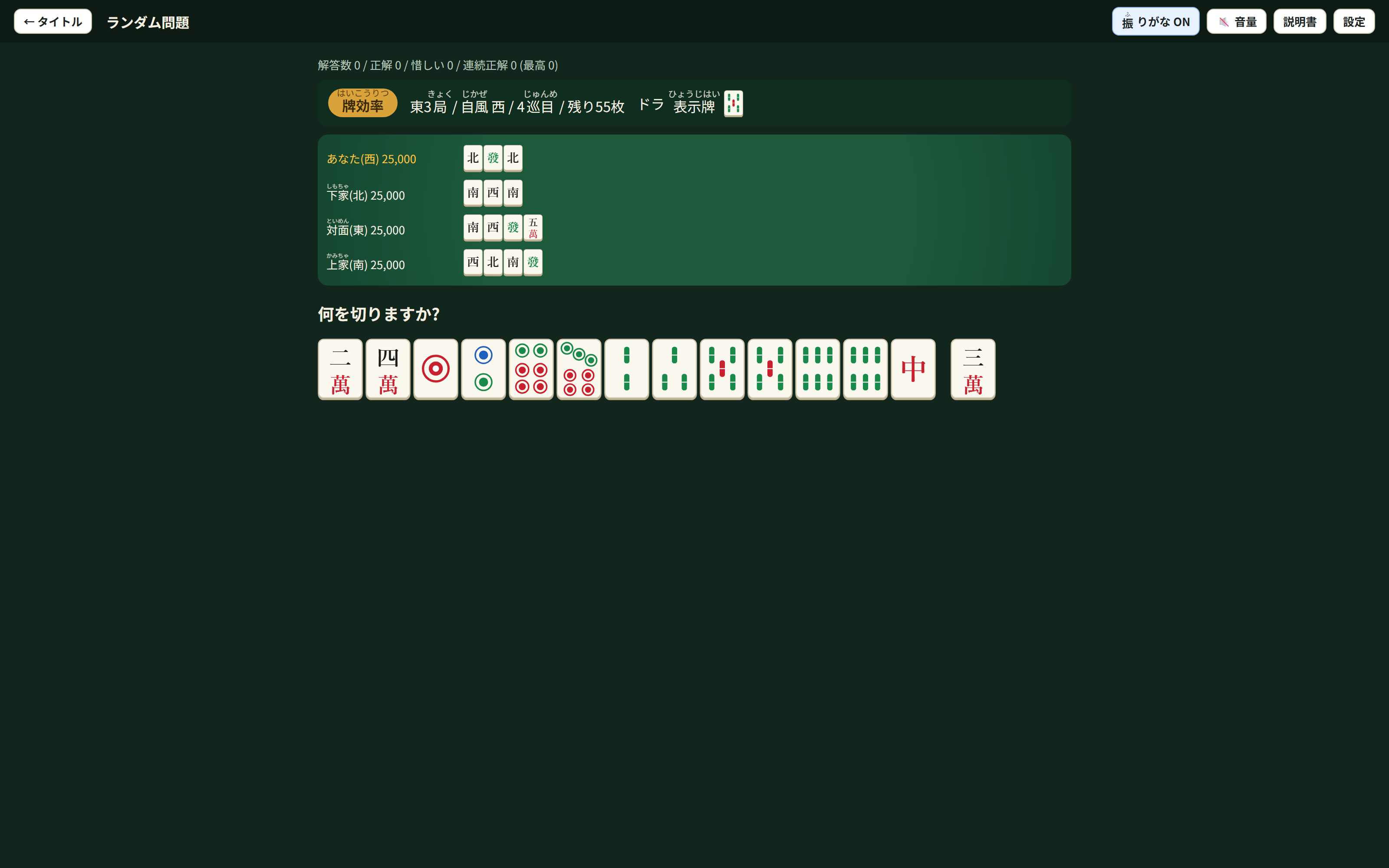
Practice Problems Based on "Real Battles" Created by AI
The highlight of this update is the "Random Problems" mode. This is a mechanism that progresses a real battle between CPUs halfway and asks the user for the "next move (what to discard)" from that specific situation.
The biggest feature is that when a user provides an answer, the AI not only judges whether it is correct or incorrect but also automatically explains the reason.
All of these problems and explanations are based on the same analysis algorithm (the mechanism by which AI analyzes the situation) as the "Flow Explanations." Because judgments can be made based on consistent standards, the design makes it harder to feel contradictions during learning.
- Realistic situation settings simulating real CPU battles
- Automatic explanations are displayed in addition to correctness judgment
- Highly reliable explanations based on a consistent algorithm
UI/UX Considerations to Prevent Beginners from Giving Up
Mahjong contains many specialized terms, which is one of the reasons beginners give up midway. Therefore, several improvements have been made in this tool.
First, I equipped a feature that allows for "furigana" (phonetic readings) to be added to mahjong terms. This allows users to smoothly grasp the screen even if they are not yet familiar with the terminology.
Additionally, an "instruction manual" containing a list of hands (yaku), basic knowledge, defensive strategies, scores, and a glossary is permanently stationed on the right side of the game screen. The key point is that if there is something you don't understand, you can check it on the spot without stopping the match.
- Lowering the barrier of terminology with the "furigana" feature
- Basic knowledge can be checked anytime with the instruction manual stationed on the right
- Fully automated matches for hands, scores, and mu-chousu (number of tiles away from winning) have been tested
Technical Improvements for Smooth Operation
As a tool that runs in the browser, I prioritized stress-free usability. I am particularly particular about the handling of BGM and sound effects.
Normally, preparing sound files involves external communication, but this tool adopts a mechanism that synthesizes sound within the browser. Because no external communication occurs, it achieves smoother operation.
Please note that at this point, the rules for "intermediate flow ends," "nagashi man-gan," "pao," and "nishi-iri" are not supported. These are parts left as room for future expansion.
- In-browser sound synthesis that minimizes external communication
- Design to achieve smooth usability
- Unsupported rules: intermediate flow ends, nagashi man-gan, pao, nishi-iri
- Those who want to learn the basics of mahjong but are unsure where to start
- Those who want to easily try an AI-powered learning tool on their own PC or browser
- Those interested in creating their own coaching tools for specific fields (in this case, mahjong) using AI
- Algorithm
- Refers to the procedures or calculation mechanisms for solving a problem.
- Mu-chousu
- An indicator in mahjong showing how many more tiles need to be drawn to achieve a win (agari).
- Flow end (Ryukyo)
- A situation where no one can win, and the match ends at that point.
FAQ
Is this tool paid?
According to official information, it is available for free and does not require registration.
Are the AI's answers accurate?
They are generated based on a consistent analysis algorithm, but due to the nature of AI, they do not cover everything perfectly. Please use it strictly as a learning aid.
AI Mahjong Dojo is a browser-based mahjong learning tool for beginners developed using AI (Claude). By providing "What to discard?" problems generated from real CPU battles and automatic explanations based on consistent analysis, the AI supports points where beginners easily get stuck. The design is characterized by a thorough pursuit of "ease of use for beginners," including features like furigana and a persistent instruction manual.