
[My Homegrown AI Diary #2] Knowledge Increased by 4658 Items in Just 2 Weeks! The System to Raise Your Own Personal AI
Have you ever thought, "I want to efficiently teach my personal AI only specific knowledge"? In this experiment, I am building a personal knowledge base in the AI's "brain" by having it read news every day. I will share the results in detail of how the total number of knowledge items jumped about 5 times from the previous time in just 2 weeks.
- Using a mechanism called RAG to accumulate knowledge in a semantically searchable format
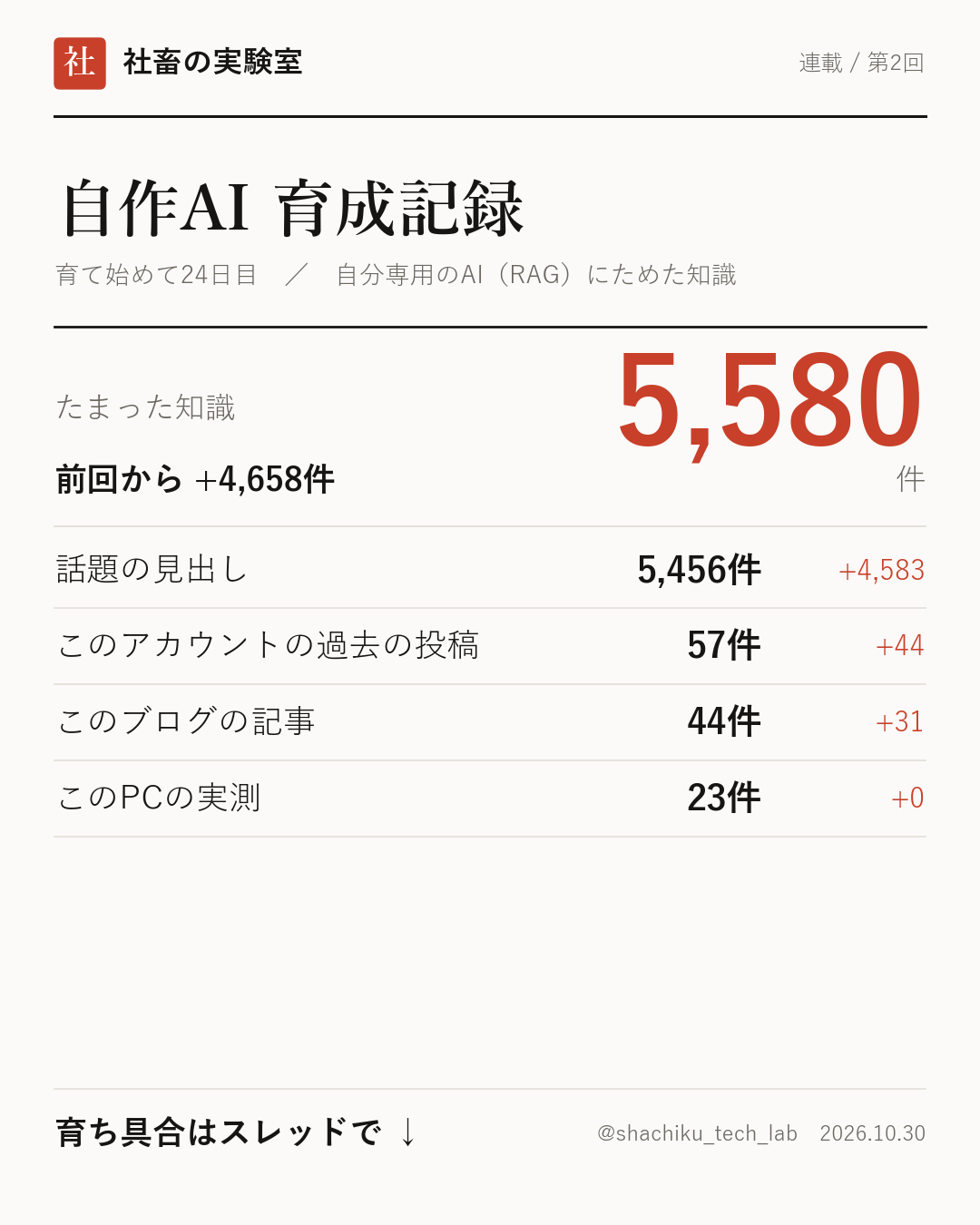
- Collecting headlines of trending AI articles daily, possessing a total of 5580 pieces of knowledge
- Efficient operation by utilizing only the PC's CPU, keeping GPU load low
- Automatically extracting highly relevant headlines from the keyword "ChatGPT"
The "RAG" Mechanism for Building Your Own Knowledge Base
What I am working on this time is the construction of a mechanism called "RAG (Retrieval-Augmented Generation)" to let AI learn (or refer to) specific external knowledge. RAG is a technology where, when an AI generates an answer, it finds relevant information from a pre-prepared database and creates an answer based on that.
In this experiment, I am collecting AI-related articles that are trending on platforms such as note, Zenn, Qiita, and Hatena Bookmark on a headline-by-headline basis. The important point is that I am not simply storing text; I am saving it in a "semantically searchable format."
Specifically, I am using "bge-m3," an "embedding model (a model that converts sentences into numerical vectors that computers can easily understand)." This makes it possible to retrieve knowledge based on content similarity, not just keyword matches.
- Selection of information: I do not save the full text of other people's articles; only headlines, short summaries, and links are accumulated.
- Optimization of computing resources: Knowledge search (embedding) processing is executed using only the PC's CPU. By keeping the GPU free for AI processing that writes text, I maintain smooth operation.
Accumulated 4658 Items of Knowledge in Just 2 Weeks
It is the 24th day since I started this training on October 6, 2026. In these 2 weeks alone, the accumulated knowledge increased by 4658 items from the previous time (922 items), reaching a total of 5580 items.
Looking closely at the breakdown, the majority of the collected knowledge is made up of "Trending Headlines (5456 items)." In addition to this, I am constructing a multi-faceted knowledge base by combining this blog's articles (44 items), actual measurement data from my home PC (23 items), and past posts from this account (57 items).
- Trending Keywords (those that were particularly frequent in these 2 weeks):
- ChatGPT (85 items)
- Claude (77 items)
- Claude Code (61 items)
- Agents (56 items)
- Local LLM (38 items)
Results of Actually Retrieving Knowledge
Now that knowledge has accumulated, I tried retrieving related knowledge using the word "ChatGPT." The AI automatically extracts up to 6 semantically similar items from the vast number of accumulated headlines.
The extracted results are as follows. All of these were automatically selected from the accumulated "Trending Headlines."
- Started learning by making an English app with ChatGPT
- How to create Excel functions with ChatGPT | 10 practical examples you can copy and paste
- [October Week 2, 2026] ChatGPT's Chat field becomes GPT-6
In this way, when you ask the AI about a specific theme, it becomes possible to instantly present the latest related topics and specific use cases.
- Point👇: The more knowledge increases, the better the AI can pick up "more specific and practical information."
Summary and Future Outlook
The purpose of this experiment is not just to stuff knowledge into the AI, but to efficiently organize "information directly linked to my work or interests" and have the AI handle it.
Since it is currently running on the CPU only, it is a very realistic operation in terms of speed and resources. In the next report (Part 3) in 2 weeks, I will report on what changes the increase in knowledge brings to the AI's response accuracy.
What kind of knowledge would you like to teach your personal AI? Please let me know your ideal AI image, whether it's for work efficiency or diving deeper into hobbies.
- Those who want to have their work knowledge learned by an AI
- Those who want to know the specific mechanism of RAG
- Those who want to run AI efficiently in a local environment
- RAG (Retrieval-Augmented Generation)
- A mechanism where a generative AI searches and retrieves relevant information from an external knowledge base when generating an answer and constructs the answer based on it.
- Embedding Model
- A model that converts data such as text into a list of numbers (vectors) that can calculate semantic similarity.
- GPU
- A processor specialized in image processing and large-scale calculations. It is often used for AI training and advanced inference.
- CPU
- The basic processor that acts as the brain of the computer. It excels at general-purpose processing.
FAQ
Why don't you save the full text?
While not official information, I take the policy of avoiding saving the full text of other people's articles from the perspective of copyright, etc., and instead accumulate only headlines, summaries, and links.
Isn't it slow running on only the CPU?
In this mechanism, I am prioritizing the advantage of being able to preserve GPU resources for writing text by leaving the knowledge search part to the CPU.
Part 2 of the experiment to raise a personal AI (RAG). Collected 4658 items of knowledge in 2 weeks and enabled semantic search using the bge-m3 model. Reporting the current status where trending AI news can be automatically organized and extracted through efficient operation utilizing the CPU.