[Kabegami Studio Vol. 2] A 3-Tier Strategy to Solve the Problem of a 'Mysterious Second Figure' Appearing in Landscapes
You intended to draw a landscape without any people, yet somehow an unnatural figure or a distorted second body appears in the far distance... Have you ever experienced this?
- Do not trust AI output completely; a system that forces important tags is effective
- The 'strength of additions' during high-resolution upscaling is a major factor in the occurrence of a second figure
- The key is to switch between positive and negative tags depending on the number of people you want to depict
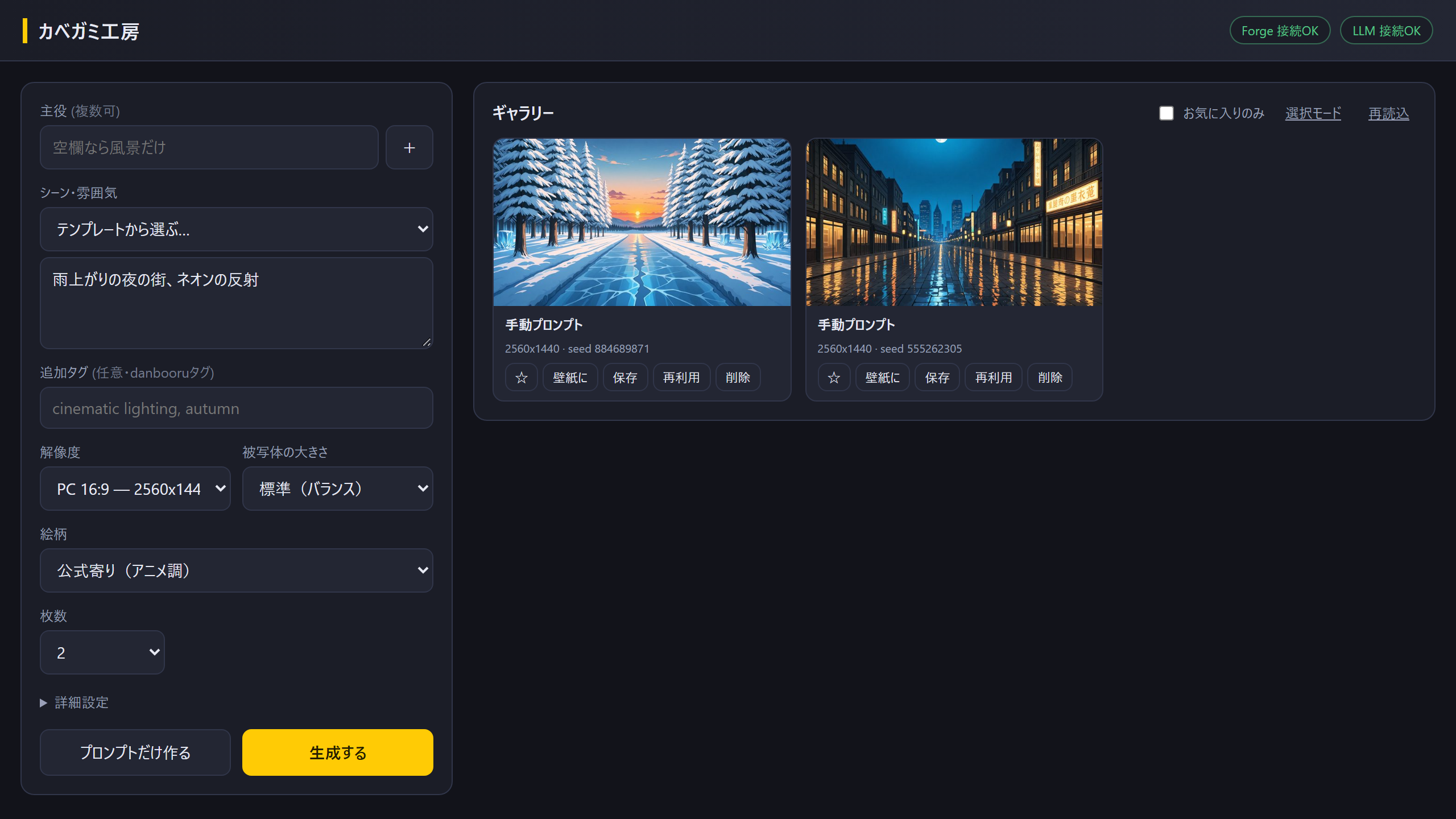
Covering AI 'Oversights' with the System
What was revealed in this experiment is that AI (generative AI) sometimes 'oversights' the instructions we value most. For example, even when giving a 'no people' instruction, it ignored this command at a rate of about 1 in 3 times, resulting in people sneaking into the landscape or a distorted second figure being drawn in the background.
To solve this problem, I introduced a design that intentionally does not fully trust the AI's output. Instead of leaving important keywords like '1 person' or 'no people' to the text generated by the AI, I made them forcibly inserted from the program side. By fixing these on the system side, we create a mechanism to preemptively prevent failures caused by AI 'oversights'.
- Identify tags that the AI tends to overlook
- Fix important tags on the system side
- Maintain the intended composition while restricting AI freedom
A '3-Tier' Defense to Prevent the Second Figure
To prevent unintended duplications, I combined and implemented the following three measures. Performing these as a set improves the stability of the generation.
The first is forcing the '1 person' specification through the system. The second is adding negative tags (tags that specify elements you do not want the AI to draw) to cancel out duplications. The third, and most important point, is suppressing the 'denoise' value to 0.35 during the high-resolution upscaling process.
High-resolution upscaling is a process that increases the resolution of the original image, but in this process, the AI 'adds' elements that do not exist in the original image. The higher the strength of these additions, the more likely the AI is to spontaneously create new elements (such as a second figure), so it is crucial to keep this numerical value low.
- Force the '1 person' specification
- Use negative tags to cancel out duplications
- Suppress the strength of high-resolution upscaling (denoise) to 0.35
Switching Prompts Based on Number of People and Adjusting Art Style
Conversely, when you intentionally want to draw two or more people, a reverse approach is needed. If you leave the '1 person' specification in the positive tags (elements you want drawn), the AI may try to force the elements to merge, resulting in them being grouped into one person. Therefore, the trick when drawing two or more people is to remove the '1 person' specification or deliberately move it to the negative side.
Finally, I would like to mention the control of the art style. If no measures are taken, the AI sometimes leans too much toward 'semi-realistic' (textures close to real photos), which can give an eerie impression. To prevent this, I place tags related to the art style at the beginning of the prompt to adjust and cancel out realistic elements that might unintentionally mix in.
- Remove the '1 person' specification when drawing two or more people
- Dynamically switch tags according to the number of people you want to draw
- Place art style tags at the beginning to prevent a bias toward realism
Summary
To create ideal images with local AI, it is important to understand the characteristics of AI (such as dropping tags or drawing random things when increasing resolution) and compensate for them through system and prompt ingenuity. By combining these 3-tier measures, you can achieve more stable landscape generation.
In the next installment (Vol. 3), I will explain 'image detail,' which has a greater impact on quality. It has been discovered that the key to determining detail actually lies in the 'size of the subject.' Please look forward to it.
Have you ever had an experience where something unintended was added when creating images with AI?
- People who want to run AI on their own PC to create wallpapers
- People who want to know the cause of why AI spontaneously draws strange things
- People struggling with fine-tuning prompts
- Negative tags
- Keywords for specifying elements you do not want the AI to draw (people, text, low quality, etc.).
- denoise
- A value that controls how much new content is added to the original image during processes such as high-resolution upscaling.
- Semi-realistic
- An intermediate art style that has a texture close to real photos, but is neither a complete illustration nor a complete photograph.
FAQ
Why does decreasing denoise reduce the appearance of a second figure?
The higher the denoise value, the more aggressively the AI tries to add elements that are not in the original image. Therefore, during high-resolution upscaling, the possibility of the AI judging 'someone might be okay here' and generating a second figure increases. By suppressing the value, it becomes easier to maintain the original composition.
If I remove the '1 person' tag, can I really draw two or more people?
Yes. When there is a strong constraint like '1 person,' the AI tends to try to force elements into a single unit. When drawing multiple people, you can give the AI the 'room' to place multiple people by removing this constraint or moving it to the negative side.
To prevent the 'second figure' that AI spontaneously adds, three measures are effective: forcing tags via the system, utilizing negative tags, and suppressing the strength of high-resolution upscaling (denoise). Understanding the habits of the AI and controlling it from both the system and prompt perspectives is the shortcut to ideal generation.